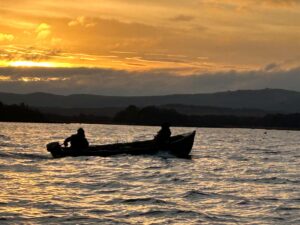
Good morning from a cool but dry Foxford. The past few days have been a taster to what winter is really like and I for one did not like it, cold, wet and miserable.. Yuck. There was very little opportunity to get out fishing. We did manage a session on after Pike last Saturday and that was good.

By now, most seasons, we would have a fair idea of where we stand. Not this time and there is a particular kind of uncertainty hanging over the Moy this year. It has nothing to do with water levels or the colour of the river after rain. It is the uncertainty that comes from not knowing what the rules will be.The consultation on the future management of Ireland’s wild Atlantic salmon closed at the end of October and we still know nothing. The proposals on the table were significant enough to make any regular Moy angler sit up and take notice—tighter bag limits, a higher harvest threshold, restrictions on the spring period. And yet, here we are, heading into another season, still waiting.

The Enquiries Are Coming In
I write this blog for anglers, but I am under no illusion about who else reads it. This page is read within the angling community, and it is read by people in positions where decisions get made. Good. That is exactly why I am writing this.
Over the past few weeks, Tiernan Brothers and the wider Moy network have received a steady stream of enquiries from anglers trying to plan the season ahead. Not just from here in Ireland, but from across Europe—from Germany, from Austria, from France, from the UK, from Scandinavia. People who have fished the Moy for years, who book accommodation, hire ghillies, buy permits, and spend real money in Ballina, Foxford and beyond. Every one of them is asking the same question, what are the rules going to be?

We cannot answer them. That is an embarrassing position to be in, and it is not our fault. It is the fault of a process that has run well past the point where anglers should reasonably have been told where they stand. The Minister and the management of Inland Fisheries Ireland are the ones who can fix that, and they have not.
A Failure of Leadership
.
I am upset by this. We are trying to run a business and our area depends on the tourism generated by the River Moy. The consultation closed on 30 October. They know last season was a mess—delays in announcing regulations, licences sold while no one knew what was happening. A crazy scenario. We cannot believe that we are facing the same thing this season. The submissions are in. The science is in. The proposals were drafted months before that. There is no earthly reason why anglers, fishery owners, ghillies, and tackle shops across the Moy catchment should still be in the dark. People book holidays. They buy permits. They plan their lives around this river. The least they deserve is to know the rules before the season starts.
IFI has had a difficult few years—a long period without a full-time chief executive, and serious questions about governance and internal controls. The appointment of a new CEO was supposed to mark a new chapter, and the Minister at the time said the new chief would play a key role in strengthening governance and delivery of statutory functions.

Delivering statutory functions includes giving anglers a clear regulatory framework in reasonable time. On that measure, the organisation has not delivered. And the Minister who appointed the chief executive, and who is ultimately answerable to the Oireachtas for the performance of the agency under his remit, has not delivered either. The Minister cannot wash his hands of this. When an agency under his Department fails to make a timely decision that affects livelihoods and tourism across the west of Ireland, the buck stops with him.
I am not interested in picking a side between the Department and the agency. I am interested in a decision. However, both should be clear on one thing, the delay belongs to both of them, and so does the responsibility for fixing it.
It Is Time for Accountability
I have held back from saying this for as long as I can but enough is enough. If the Minister and the leadership of IFI cannot deliver a basic regulatory decision in a timely manner, then the question of accountability has to be asked—and asked publicly.
That is not a rash statement. It is a considered one. The role of a Minister is to set policy and ensure his Department delivers. The role of a chief executive is to run their organisation effectively and meet its statutory obligations. When both fail on something as straightforward as finalising regulations that have been in development for well over a year, the public deserves to know why, and who is responsible.
I do not say this lightly. I have no personal animus toward anyone in the Department or the agency. And I want to be clear about something else, we are not just here to criticise. We are willing to help. If there is data the Department needs from the angling community, we can help gather it. If there is local knowledge that would inform the process, it is freely available. If IFI wants to engage with the businesses and anglers who depend on the Moy, our door is open. We would rather be part of the solution than write about the problem. But we cannot do that if we are left in the dark.
The Moy, and every other salmon river in this country, deserves better than a leadership that cannot make a decision. It also deserves a partnership, and we are ready for one.
What the Delay Actually Costs
Some will say I am being too harsh. These things take time. There are submissions to review, legal complexities to navigate, scientific advice to weigh.
I understand all of that. But if a farmer was told in October that the rules for the coming year might change but he would not know until spring time , he would be furious. The angling trade may not have the lobbying power of the farming sector, and perhaps we are not seen as important to the country. But we are a vital cog in the tourism offering of the Moy valley. We now have to invest in stock and plan for the year ahead without knowing whether the regulatory goalposts will shift. Is that fair? Anglers and fishery owners are no different from anyone else in business. The Moy is not a hobby for everyone involved. It is a livelihood. It is a tourism draw. It is a resource that depends on people being able to plan. And every unanswered enquiry is money that may end up on another river in another country.
There is a bitter irony here too. The consultation document itself recognised that recreational anglers are not the main cause of the decline in salmon stocks. The Department knows anglers are not the problem. Yet it is anglers who are left hanging.
The Minimum We Should Expect
If the Minister and the leadership of IFI cannot deliver a decision before licences go on sale, normally around Christmas, they should explain why. Not in a press release full of civil service language, but in plain terms. What is the hold-up? What is being reviewed that was not reviewed in the past? And when, specifically, will anglers on the Moy and every other salmon river in the country know what they are dealing with?
The practical reality is. Licences normally go on sale around Christmas. If the regulations are not finalised by then, we are asking people to buy a licence for a season whose rules nobody knows. That is not a way to run a fishery, and it is not a way to treat the people who keep it going.
What You Can Do
Complaining on a blog is one thing. Putting a question in front of someone who has to answer it is another. So here is a simple ask.
Write to your local TD. It does not need to be long or clever. Three or four lines is enough: that you fish the Moy, that the 2027 regulations were consulted on last October and still have not been finalised, that anglers and local businesses are planning blind, and that you would like to know when a decision will be made. TDs respond to constituency correspondence—it is their job—and a handful of letters about a live issue carries more weight than any number of online complaints.
If you have a direct line to anyone in IFI or the Department—through a club, a federation, or a working relationship—use it. Offer to help. Offer the local knowledge. Offer the data. We are not asking for favours; we are asking for a functioning process, and we are willing to do our part to get there.
A few hundred letters asking the same reasonable question in the same month is a far more effective argument than anything I can write here. Rant over…