
An overcast morning with some wintry showers again in Foxford. It has been that way all week and while the plans have been there, the rods rigged, the reels oiled, and a new selection of spring baits ready to go, it hasn’t happened. As any angler in the west of Ireland knows, we don’t always get to choose the day and while the weather has had other ideas, we just have to go with the flow. In all honesty, we have not been in a panic. We are taking a slow relaxed start to the season, saving ourselves for when it does kick off properly. At the moment we are planning a full reopen of the shop in early March and hopefully by mid March we will see a few familiar faces reappearing through the doors.


While we wait for that first window of opportunity, it’s the perfect time to get the mind focused on the job ahead. We are happy to confirm that while the shop has been closed we have not sat on our butts all the time. Despite the uncertainty with new regulations we will be very well stocked with some absolute killer spring baits that have proven their worth time and time again on the Moy, along with a large selection of new rods, reels, lines, waders, jackets and everything else You Need.
For those chasing that first silver bar of the year, we have a great selection of Rolla Flying Cs in all the classic Moy colours—Black & Gold, Yellow & Copper, Red and Copper and the ever-reliable Pink & Silver. For those who want a different action, we are also fully stocked with the fantastic Vision One Ten lures. If you haven’t tried them yet, this spring is the time to start. They have an incredible, subtle action that spring fish often find irresistible.

With that in mind, I was looking back at a little piece I wrote this time last year. The weather might change, but the core principles of successful spring fishing remain the same. If you’re planning a trip to the Moy this spring, here’s a refresher on the tactics that put fish on the bank.
Revisiting the Spring Salmon Mindset
Travel Light
Forget settling in for a day on one pool. Early season is all about the “search.” The water is cold, and the fish are often tucked away in specific lies. You need to be mobile. Adopt the “cast and move, cast and move” mentality. The more water you can effectively cover, the higher your chances of finding a resting or fresh-run fish that’s willing to play.
Pick Your Spot
Thankfully, salmon are creatures of habit. The lies that held fish last spring will almost certainly hold them this year, provided the riverbed hasn’t changed dramatically. While there’s always an element of exploration, focus your energy on the pools and glides where you’ve seen fish caught before or have had pulls yourself. Summer is the time for exploring new water; spring is for targeting the hotspots.

Time
There’s a reason the last hour of daylight is often referred to as the “magic hour” in spring. Whether it’s the slight increase in water temperature after a day of weak sun, or just the fact that the fish seem to switch on, the evening can be dynamite. If you do spot a fish showing or moving in a pool late in the evening, make a mental note. Be the first angler back to cover that water first thing the next morning.
Slow and Low
This is the golden rule of cold-water fishing. A lethargic salmon in near-freezing water is not going to charge across the pool to grab your lure. You have to put it right in front of its nose. The key isn’t just the retrieve, but the depth. You need your fly, spinner, or lure to be tipping the bottom. Hanging that bait in the strike zone for those extra few seconds is what separates a blank from a bent rod.
Does Size Matter?
I’ve seen springers come to tiny size 14 flies and equally to 11cm Rapalas. So, there’s no hard and fast rule. However, if I had to lean one way, it would be towards the larger offerings. Why? Because they inherently fish a little deeper and slower, keeping you in that low-and-slow zone for longer. There’s also the “reaction strike” theory—a bigger, more intrusive profile might just be enough to annoy a resting fish into taking a snap.

The Colour Code
On the Moy, you can rarely go wrong with a core palette. For fresh-run fish, brightness seems to be a trigger. Think of combinations of Black, Yellow, Blue, Silver, and Copper. Whether it’s a hair-wing fly or one of those new Rolla Flying Cs, if you have a mix of these colours on your line, you’re in the game.

A Kelt, note how skinny it is in comparison to the fresh run fish
A Note on Our Kelts
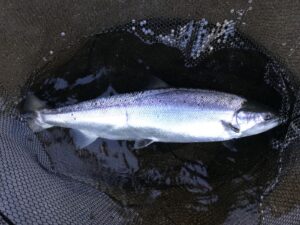
Before you head out, a friendly reminder: there are still plenty of kelts (spawned fish) heading back to the sea. It’s easy to get a racing heart when the line tightens, but please take a moment to identify your catch. A fresh springer is a thing of beauty—thick in the girth, bright silver, with loose scales and bright red gills, sometimes with sea lice still attached. A kelt will be thinner, often with a distended vent and ragged fins. By law, they must be returned carefully to the water to complete their journey and return as a much larger fish in the future.

Fresh Spring Salmon (top) Kelt (bottom). A very noticeable difference but its not always this easy.
Let’s Get Out There
There’s probably a lot more we could add, but if you head to the Moy with these few things in mind—travelling light, fishing slow and deep, and choosing the right lure from a well-stocked box—your chances of feeling that heart-stopping pull are high.
Tight lines, everyone!